By David meridith
Geelong Gliding Club (GGC) is based at Bacchus Marsh and operates off of long, flat runways with grass and sealed surfaces. It’s a busy site with lots of other aviation activity happening daily. Most members fly the club fleet, while around 10 members own private gliders. Few members carry ballast. The club does a lot of training and normally has 10 to 15 pre-solo students in its membership.
A Financial Dilemma
In FY 2023 we had a $26K 100 hourly service on our Pawnee SSO – a combination of many little things and several cracked pots. This, after the pandemic shutdown, caused the club some financial stress. FY 2024 was a better year financially and the situation improved - flying hours were up and new members joined. Unfortunately, the surplus of 2024 was quickly cancelled out by another $26K bill for SSO’s 100 hourly, which includes the ongoing spar inspection process. All of this means that the cost per minute of aerotow had doubled in 15 years and the cost of going solo is $1,000 higher than it was 5 years ago. The spars then failed inspection, so the club was facing the prospect of spending at least $80K on the Pawnee to get it back on line.

Options
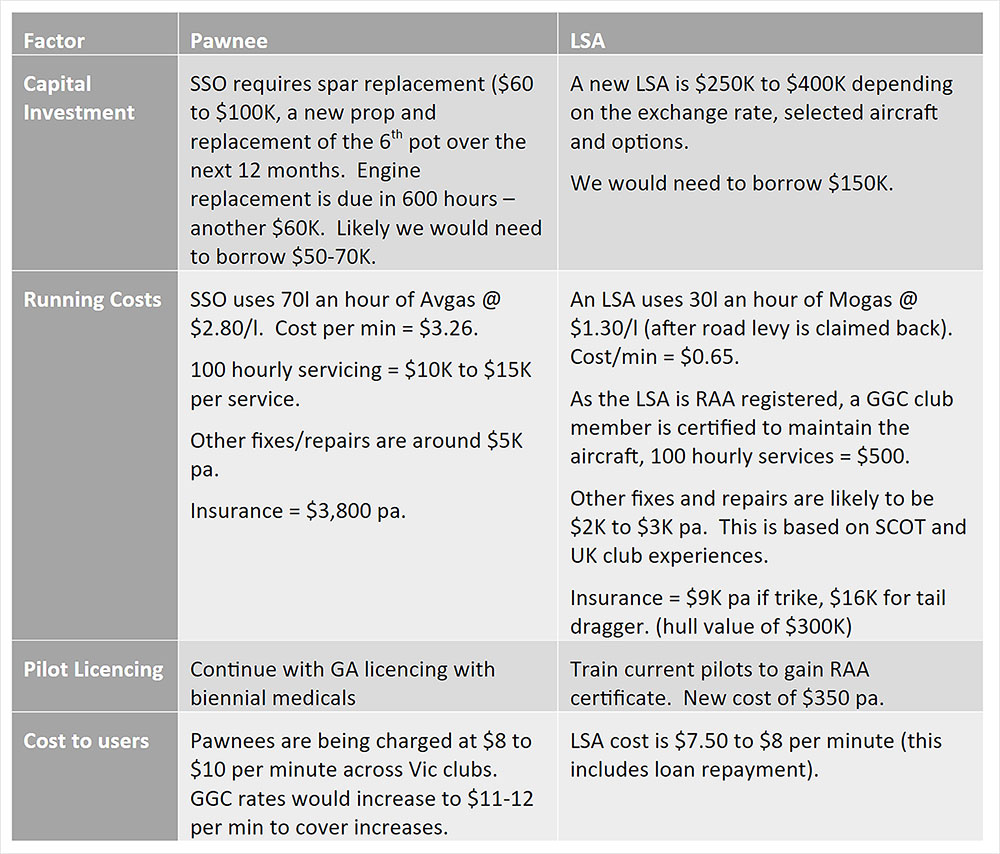
A subcommittee went to work considering several options. The choices boiled down to either investing in the 50 year old Pawnee, purchasing a Light Sport Aircraft (LSA) or both. We had to decide what would serve us best for the next 20 years. The factors considered are in the table to the left.
Assessing Performance
While the economics of the change were straightforward to calculate, the performance differences were harder to assess. We went to Tasmania and flew with the Soaring Club of Tasmania (SCOT) to try their Eurofox 141HP tug. Seeing was believing. 200kg of pilots in a Twin Astir climbed consistently at 700ft/min. On the strength of this experience - and info from Hunter Valley - we decided to go down the LSA route.
A presentation made by James Nugent on this topic provided further detail. To summarise his presentation, performance is a function of Power, Drag, Thrust (propeller efficiency) and weight. Let’s consider power first. The Pawnee has lots of power – 235 to 260 HP in most cases. This is almost twice the power of the 141 or 160 HP LSA. So, the Pawnee starts with a really big power to weight advantage:
However, an LSA:
1. is more aerodynamic, creating less drag.
2. uses a modern prop, creating more thrust.
3. is 600kg lighter.
4. uses a turbocharged engine, with no degradation with high temperature and altitude.
To Conclude
1. The Pawnee has a slightly better Power/Weight ratio when towing bigger gliders, so it will accelerate better. Therefore, for obstacle clearance on a short runway with a heavy glider, you need a Pawnee.
2. For overall aerotow performance, a modern LSA towplane is comparable and even superior in climb rate, cycle time and cost (except for the obstacle scenario). The SCOT Eurofox was comfortably launching 800kg gliders at Joeyglide in 30 degree + heat with a tail wind.
3. A Pawnee is strong, proven and more stable than an LSA. But is it worth the $30 per launch premium?
Managing Risk
Modern design methods enable an LSA to keep the weight off, but existing tug pilots express concern over the robustness of the airframe, cross wind performance and the relatively heavier gliders pulling them around the sky. The decision to purchase was not unanimous at GGC, but after a vote, we have all become focused on our new world and accepted the risks associated with an LSA. The risk will be managed by:
1. Carefully assessing situations where heavy gliders are being towed and clearance is limited.
2. Manufacturer warranty. We are lucky to be close to the Australian agents for Eurofox and Rotax, who have a great deal of knowledge and expertise if needed.
3. Purchasing the Rotax Care warranty program, and monitoring engine performance for early warning of issues.
4. Monitoring and learning from other operators. 16 Eurofox 915s now operate in the UK and two in AUS. Also, as data is received from users, Aeropro continues to tweak the design.
5. Purchasing the trike option. This reduces problems experienced with prop strikes and tail wheels – the main issues experienced at Hunter Valley to date, where they have the tail dragger version).
6. Sufficient familiarisation/training with the Eurofox by our club’s tug pilots.
Choosing the LSA
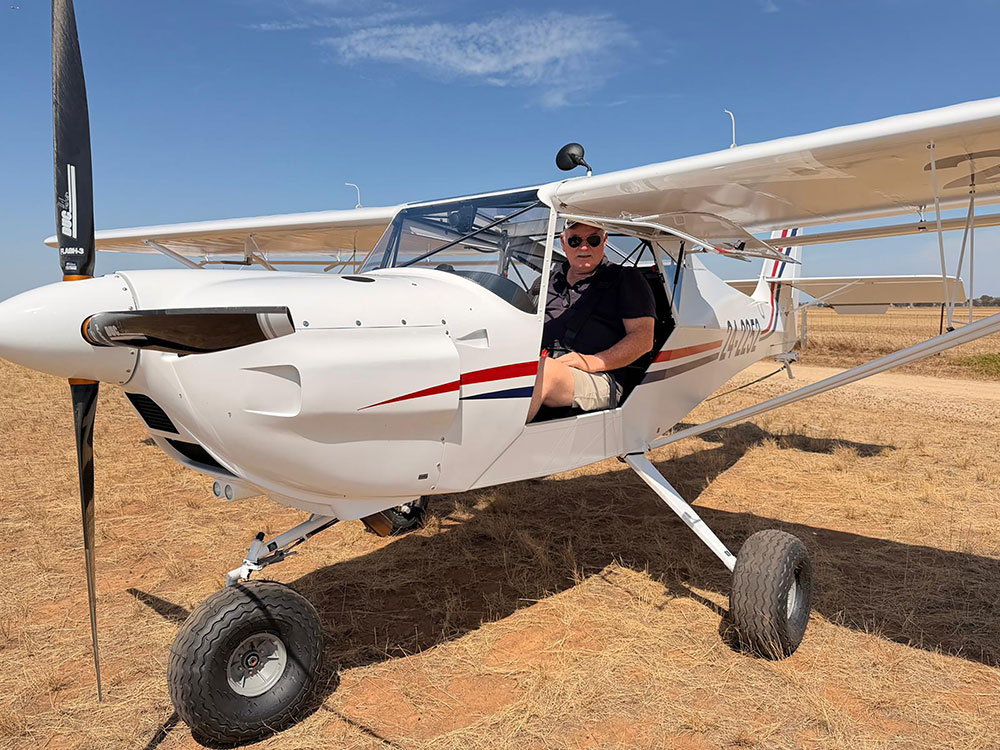
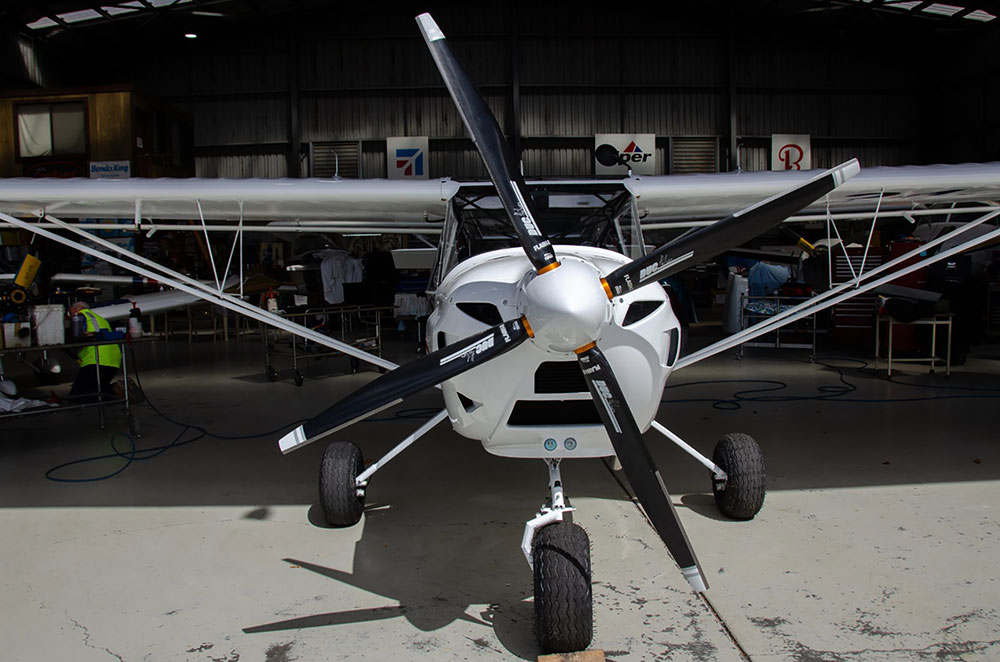
There were three main contenders, the Eurofox 915, Bristell and the WT9 Dynamic. All three are beautiful aircraft, recently designed in Czechia or Slovakia and proven tow planes. The latter two have the 916 engine. We ended up choosing the Eurofox 915 because we know it does the job, it won’t be the only one in Australia and it had the lowest cost of all three.
Our final bill was $290K (at an exchange rate of 0.56). All three options are well supported in Australia and customer service has been good. The Bristell is metal, around $320K and the Dynamic is composite and around $400K. If money was not an issue, we would have picked the Dynamic given the 160 HP engine and greater performance/comfort. All prices are ex GST.
Delivery
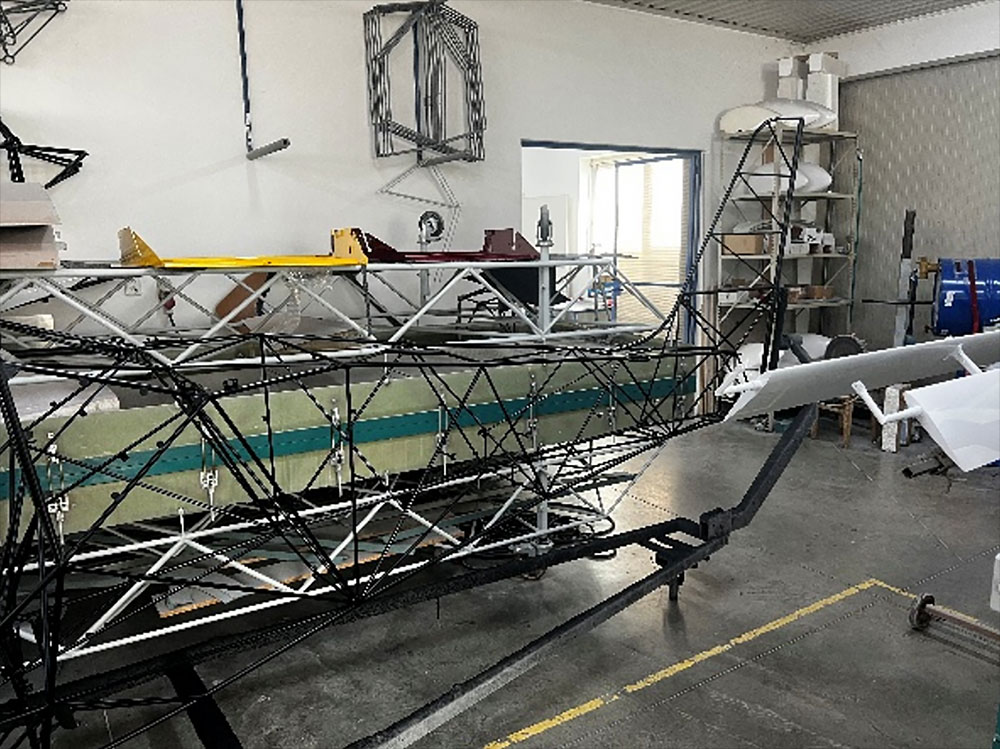
The Eurofox was ordered at the start of June and Aeropro started on the frame two weeks later. We spent a fair bit of effort with Horsham Aviation, the agent, working out the best mix of options for us. This helped to keep the cost down. We continue to seek photos of the aircraft as it progresses. We were hopeful that it would arrive in time for our Christmas camp.
Financing the Purchase
The club had some cash reserves and sold a glider to get the first milestone payment made. We then borrowed bridging finance from several of our club members for the remainder of the purchase. Once we have the tug earning, we will draw down a loan from Gliding Australia and pay that back over 5 years.
GAus offers a great scheme for clubs to access funding, but I can’t stress enough that many of the boomers around your club have savings that you can use. Geelong offered a rate a bit higher than what banks are charging for term deposits, so it wasn't a problem to find the cash we needed at an affordable cost.
The Future
We are confident that we will retire our debt over 5 years and then be in a much stronger position. In June 2025, our fuel bill was $2,800. The equivalent fuel cost for the Eurofox would have been $600 – this saving alone will cover our repayments. Good luck with your tug upgrade plans.
Part 2 – It’s Now Here and Operating
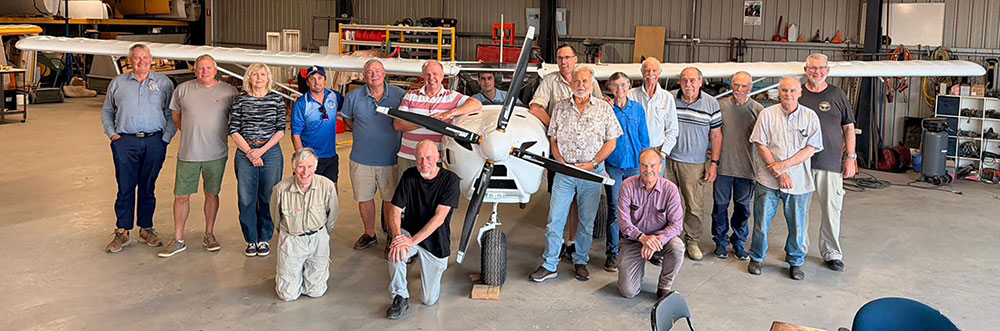
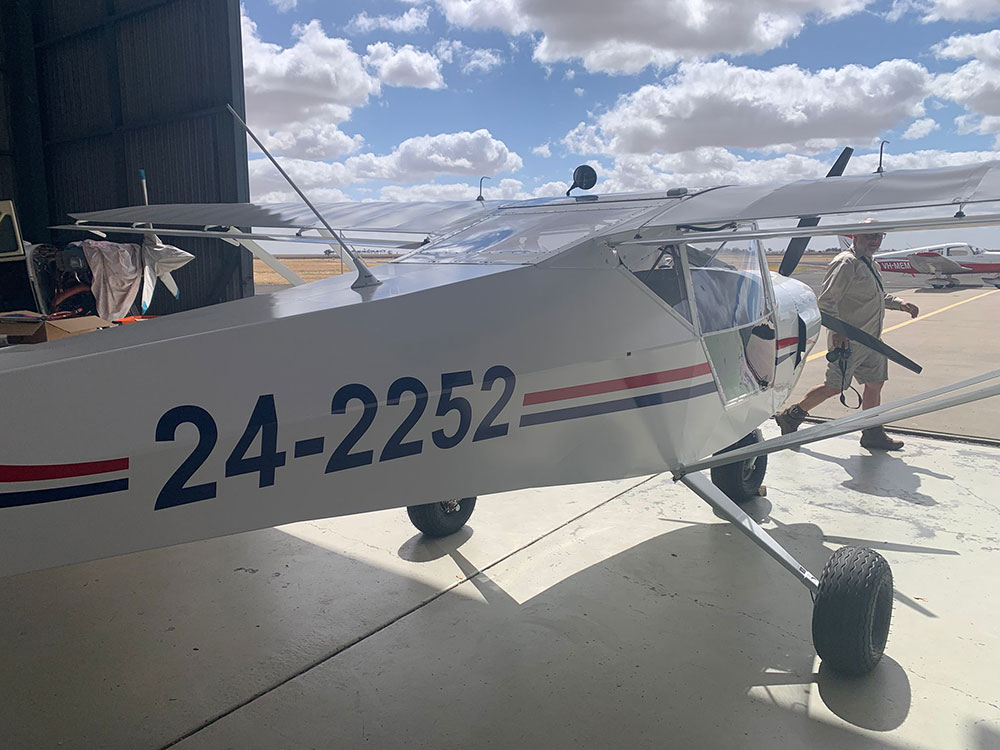
The Order to Delivery time was eight months, with five months to build, two to ship and three weeks in customs - very frustrating. Horsham Aviation were brilliant when they got it, taking just 4 days to build it and get the aircraft Permit to Fly. Don, one of our club members, spent the week there helping and learning about the aircraft. He will shortly get his L2 maintenance rating and do the majority of maintenance. Total cost was $291,000.
The first weekend of operation was excellent with 5 hours of flying and 36 launches done. Martin our tug master is now systematically training up our tug pilots to fly 2252.
Discussions with Ian, who got his conversion to 2252 on the first weekend, recognised that it is certainly lighter than the Pawnee and the glider position has a larger influence on speed control. The glass panel and engine controls will require a bit more time to get used to. But he reckons it’s fun to fly and he looks forward to his next rostered day.
The majority of launching for the first weekend was two seaters and times were slightly better than our old Pawnee SSO - ie 8 to 10 minutes for a 3,500ft AGL tow. The fuel usage averaged out at $30/hour, equalling the budget. With an 80l fuel capacity, there is no need to fill up during the day.
We have drawn down the GAus loan and paid back the bridging finance borrowed from five of our club members. Repayments to GAus are $2,425 for 60 months. After that we will own the aircraft. We have not altered our towing charge. The savings in fuel and maintenance will more than cover the cost of repaying the loan.
The Nose Wheel Leg Incident
Just prior to delivery of 2252, we were using the Soaring Club of Tasmania’s (SCOT) Eurofox – identical to ours, which was on its way back home after supporting Joeyglide. While taxiing the aircraft, the nose wheel leg broke – a result of a cracked weld. Aeropro immediately investigated the incident and revised the manufacturing process for the leg. They have also strengthened the assembly and we now have a replacement fitted to 2252 by Horsham Aviation, two weeks after the incident.
For some people, this description is all the proof they need that the entire aircraft is no good. For some people, it’s proof that we have a responsive and serious supplier. Which camp are you in? What would be your response to a weld failing on a Pawnee, Callair or any other established type?
Still to Come
GGC has seen the benefits of the Eurofox, but we have kept the Pawnee, pickled and down the back of the hanger… just in case. Worse case, we can find money to change the spars and bring SSO back online – but it will be charged out at over $12 a minute to pay for the spars. We continue to monitor 2252, aiming to confirm it delivers the promised financial and operational performance.