A practical guide for glider pilots, instructors and tow pilots
One of the questions that regularly comes to Operations concerns which medical certificate a particular pilot actually needs.
For an individual who only flies gliders, the answer is generally straightforward. It becomes less obvious when the same person also instructs, flies a VH-registered tow aircraft, operates an RAAus tow aircraft, or does all of these.
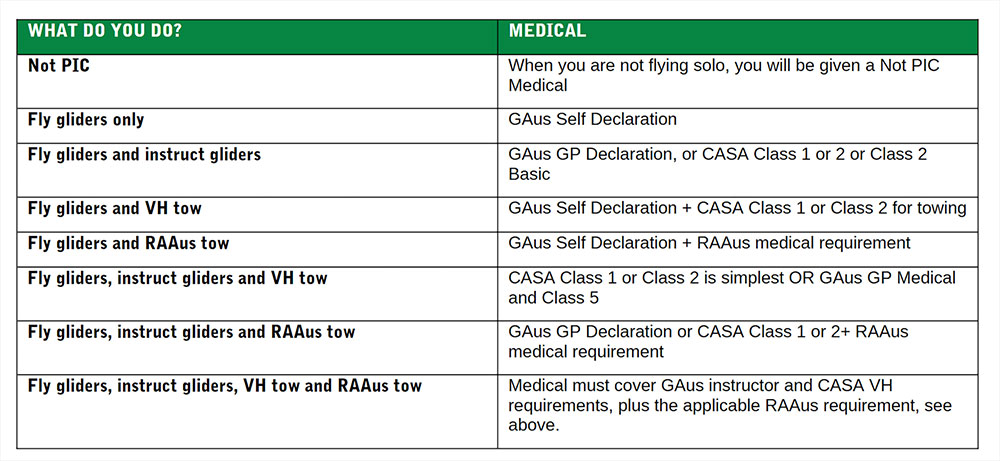
The key is not to ask, “What medical certification do I have?” The better question is “What flying am I going to do, and does my medical cover all of it?” The table above is a starting point. The medical you need ultimately depends on the privileges you are exercising and any conditions or limitations attached to the medical.
IF YOU JUST FLY GLIDERS
For most glider pilots, the GAus Self Declaration is the normal medical pathway.
A pilot can also meet the GAus requirement through a GAus General Practitioner Declaration or a CASA Class 1 or 2 medical certificate.
If you are an eligible pilot who flies gliders and does not instruct or fly tow aircraft, the GAus Self Declaration will normally be all you need.
There are circumstances where a medical condition means that you cannot use the Self Declaration. In that case, medical assessment may be required. A CASA Class 5 medical is not acceptable for flying gliders. Class 5 comes with restrictions not suitable for gliding.
IF YOU INSTRUCT
A GAus instructor needs a GAus General Practitioner Declaration or CASA Class1, 2 or Class Basic medical. For many instructors who only fly gliders, the GAus General Practitioner Declaration is therefore the logical option. If you already hold an appropriate CASA medical, such as a Class 1 or Class 2, that certificate can also satisfy the GAus medical requirement for your gliding and instructor privileges.
IF YOU ALSO FLY A VH TOW PLANE
When you fly the glider, you are operating under the GAus medical requirements. When you climb into a VH-registered tow aircraft, you are exercising CASA flight crew licence privileges and the CASA medical requirements become relevant.
The medical you use must be appropriate for the operation you are conducting. For a member who flies gliders solo and instructs in gliders and flies a VH tow aircraft, a current Class 1 or Class 2 Medical will commonly provide the simplest pathway. But you could have a GAus GP Medical (it covers solo and glider instructing) and a CASA Class 5 for the towing component.
WHAT ABOUT BASIC CLASS 2?
CASA's Basic Class 2 provides another medical pathway, but it comes with operational limitations.
Do not assume that because your medical allows you to fly an aeroplane privately, it necessarily allows every specialised aviation activity you might want to conduct. If you intend to use Basic Class 2 while conducting aerotowing, check that the medical conditions are compatible with the operation. A typical condition is max altitude of 10,000ft AMSL, for example.
WHAT ABOUT CLASS 5?
Class 5 has created questions because, like the GAus Self Declaration, it involves self-declaration. But the two should not be confused. The CASA Class 5 Medical Self-Declaration and the GAus Self Declaration are different things. They operate under different systems and for different purposes. CASA Class 5 provides a medical pathway for eligible pilots conducting specified private operations and has operational limitations. Holding a Class 5 should therefore not automatically be taken to mean that it can be used for every type of operation, including aerotowing.
WHAT IF THE TOW PLANE IS RAAUS?
When you fly the glider, you need to satisfy the GAus medical requirements. When you fly the RAAus aircraft, you need to satisfy the medical requirements applicable to your RAAus Pilot Certificate and towing privileges. The two requirements should be considered separately, even though there may be similarities between the medical standards. You must also hold the appropriate RAAus Glider Towing Endorsement and GAus tow pilot approval.
WHAT IF I DO EVERYTHING?
Some of our members perform a full range of operations. You might fly gliders solo, instruct in gliders, fly a VH-registered tow aircraft and fly an RAAus tow aircraft. That does not necessarily mean you need four medicals. You need a medical arrangement that satisfies the requirements associated with each of those activities.
For the GAus gliding, instructing and VH aerotowing combination, a current Class 1 or Class 2 Medical will commonly provide the simplest pathway. When flying the RAAus tow aircraft, you must also satisfy the applicable RAAus medical requirements.
A MEDICAL IS NOT JUST A PIECE OF PAPER
A current medical certificate or declaration does not necessarily mean you are fit to fly today. Medical fitness can change. Illness, injury, medication, medical treatment, fatigue and other changes in health can affect our ability to fly safely. Every pilot has an ongoing responsibility to consider their fitness before flying. If something has changed, do not simply rely on the expiry date printed on the medical. Check what is required before returning to flying. Talk to your club CFI for advice suitable for your situation.
IF YOU ARE UNSURE, ASK.
Medical requirements do not need to be complicated, but they can become confusing when a member exercises privileges under more than one aviation system.
Identify everything you intend to do: Glider pilot? Instructor? VH tow pilot? RAAus tow pilot?
Then make sure your medical arrangements cover each activity. If you are unsure, ask your CFI, RMO or EMO before flying.
Dave Boulter
executive manager operations